
What Does a Pool Fire Feature Cost?
Pool fire feature cost is one of the first questions homeowners ask when they start planning a resort-style backyard — and the range is wider than most people expect.
Here’s a quick overview to set realistic expectations:
| Feature Type | Unit Cost | Total Installed Cost |
|---|---|---|
| Entry-level (concrete/steel fire bowl) | $300 – $700 | $1,000 – $1,500 |
| Mid-range (cast iron/composite) | $800 – $1,500 | $2,000 – $3,000 |
| High-end (copper/custom combo bowl) | $1,600 – $6,400+ | $4,000 – $10,000+ |
| Custom fire + water integrated features | $8,000 – $60,000+ | Varies by project scope |
The unit price is just the starting point. Gas line work, permits, labor, and accessories like fire glass or wind guards all add to the final number. For most Southeast homeowners adding a fire bowl to a new or existing gunite pool, a realistic budget lands somewhere between $2,000 and $8,000 for a complete, professionally installed feature.
Fire bowls have surged in popularity because they do two things at once: they extend how long you can enjoy your pool into cooler evenings, and they create that flickering, reflective ambiance that lighting alone simply can’t match.
I’m Lucas Pimenta, General Manager at Neway Pools, and over my 20+ years building custom gunite pools across North Carolina, Florida, Georgia, and Alabama, pool fire feature cost is something I help families navigate on nearly every high-end outdoor living project we take on. In this guide, I’ll walk you through everything that drives the price — so you can plan confidently and avoid surprises.
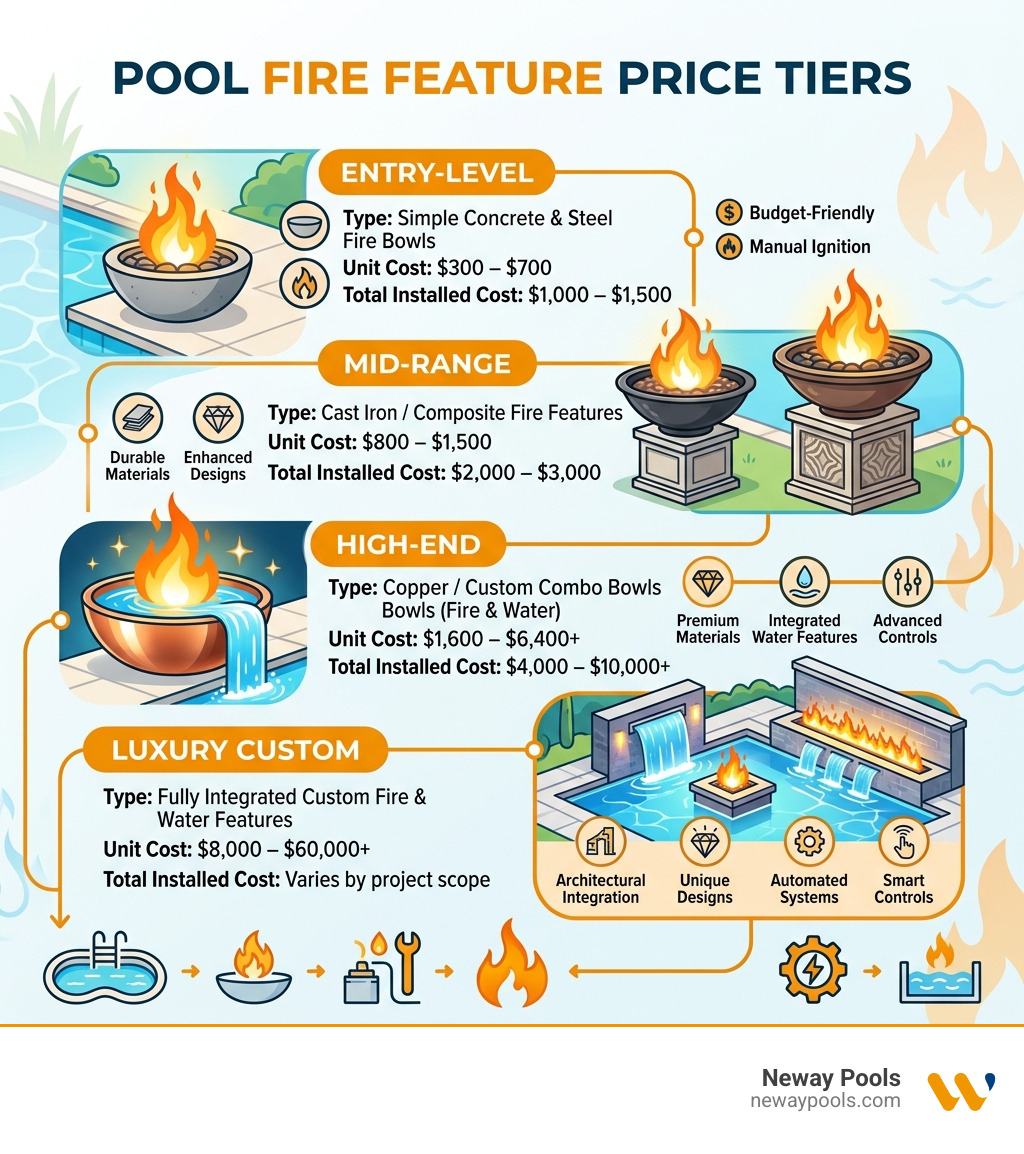
Average Pool Fire Feature Cost Breakdown
When we talk about the total pool fire feature cost, we have to look at the project as a sum of its parts. It isn’t just about the bowl you see in the catalog; it’s about the infrastructure beneath the surface. For a standard Modern Pool Fire Feature 2026, the investment is generally split between the unit itself and the labor to make it work.
Labor typically accounts for 25% to 50% of the total project cost. This includes trenching for gas lines, plumbing for water (if it’s a combo unit), and electrical work for automated ignitions. In our experience across Florida and Georgia, a single-bowl installation often falls into these tiers:
- Entry-Level ($1,000 – $1,500): This usually covers a basic concrete or steel fire bowl with a manual “match-lit” ignition. The gas line is often a short run from an existing propane tank or nearby natural gas stub.
- Mid-Range ($2,000 – $3,500): This is where most of our clients land. It includes high-quality GFRC (Glass Fiber Reinforced Concrete) bowls, professional gas line installation, and perhaps a basic electronic ignition system.
- High-End ($4,000 – $10,000+): This tier features premium materials like hand-hammered copper, dual fire-and-water functionality, and full integration into your pool’s automation system so you can light the fire from your smartphone.
If you are planning a full Pool Makeover Cost Guide 2026, integrating these features during the renovation can save you money on mobilization and permitting compared to doing it as a standalone project later.
How Material Choice Impacts Pool Fire Feature Cost
The material of your fire feature doesn’t just dictate the “vibe” of your backyard; it determines the longevity and the price tag. In the humid, salt-air environments of Wilmington, NC, or the intense sun of Panama City, FL, material choice is everything.
- GFRC Concrete: Glass Fiber Reinforced Concrete is a staple in our industry. It is significantly stronger than standard concrete and much lighter. You’ll find these units ranging from $700 to $2,500. They are excellent for resisting the UV rays and heat common in the Southeast.
- Hammered Copper: This is the gold standard for luxury. Copper bowls, like those from HPC Fire or The Outdoor Plus, can cost anywhere from $2,500 to over $6,000. While expensive, they develop a beautiful natural patina over time and are highly resistant to corrosion.
- Stainless Steel: A great middle ground for a modern look. Ensure you choose marine-grade stainless steel (316) if you live near the coast to prevent tea-staining and rust. These typically cost between $1,500 and $3,000.
Choosing the right material is a key part of the Cost To Build A Gunite Pool, as the weight of heavier stone or concrete bowls requires the pool’s bond beam to be engineered specifically to support that load.
Pricing Differences Between Fire, Water, and Combination Bowls
Adding water to the mix changes the math. A fire-only bowl is the simplest to install, requiring only a gas line. However, the “wow” factor often comes from combination bowls where fire sits atop a cascading waterfall.
- Fire-Only Bowls: These are the most budget-friendly. You are paying for the unit and a gas line.
- Water-Only Bowls: These act as decorative scuppers. While they don’t need gas, they require dedicated plumbing and a pump capable of handling the flow.
- Fire & Water Combination Bowls: These are the most complex. A unit like the Maya Concrete Fire & Water Bowl might retail for $2,500, but the installation is more intensive because you are running two separate utility lines (gas and water) to the same pedestal. You should expect to pay a $1,000 to $2,500 premium for the dual-line plumbing and specialized burner systems required for these units.
For More info about water features, it’s worth noting that combination units provide a compact way to get two features in one footprint, which is a great strategy for smaller backyards in places like Atlanta or Raleigh.
Factors Influencing Your Total Investment
Beyond the bowl itself, several “invisible” factors will drive your pool fire feature cost. The biggest variable is often the distance from your home’s main gas meter to the pool.
Fuel Types: Natural Gas vs. Propane
- Natural Gas: This is the most convenient option if your home is already piped for it. However, the upfront cost is higher because a licensed plumber must trench and run a permanent line. This can cost $15 to $40 per linear foot.
- Propane: If natural gas isn’t available, propane is the go-to. You can use small, hidden tanks inside some bowl bases, or a large buried tank for the whole property. Propane often burns hotter (higher BTUs), but you have the ongoing task of refilling tanks.
Automation and Ignition
A basic match-lit system is reliable and cheap. However, if you want the luxury of “one-touch” fire, electronic ignition systems add $1,000 to $2,500 to the price. These systems include safety sensors that shut off the gas if the flame blows out — a vital feature for windy coastal areas. You can learn more about these trade-offs in this guide on Fire Features for Your Pool: Cost, Safety, and how to choose the right one.
Labor and Utility Requirements for Pool Fire Feature Cost
Don’t underestimate the “behind the scenes” work. In many of the counties we serve, such as Gwinnett or Santa Rosa, you cannot simply DIY a gas line. You will need:
- Licensed Plumbers: To ensure the gas pressure is correct and the lines are leak-free.
- Electricians: If you are installing LED-lit bowls or electronic ignitions.
- Trenching: Digging through established landscaping or hardscaping can add $500 to $2,000 to the labor bill.
- Drainage: Fire bowls need a way to shed rainwater so the burners don’t rust or clog.
When you receive a Guide To Custom Pool Quotes, make sure these utility runs are clearly itemized so you aren’t hit with “unforeseen” costs mid-build.
Additional Expenses: Accessories and Permits
The “finishing touches” can add up quickly.
- Media ($100 – $500): Whether you choose rolled lava rocks, tumbled fire glass, or ceramic logs, you’ll need enough to cover the burner.
- Wind Guards ($200 – $600): In breezy areas like Wrightsville Beach, a glass wind guard is almost mandatory to keep the flame from flickering out.
- Permits ($100 – $1,000): Most municipalities in our service areas require a mechanical permit for gas lines.
- HOA Approvals: Some HOAs have strict rules about open flames or the height of fire features. We always recommend checking your bylaws before signing a contract.
Long-Term Value and Return on Investment
Is the pool fire feature cost worth it? From a pure real estate perspective, the answer is often yes. High-end outdoor living features can increase a home’s value by 5% to 15%. In a competitive market like Alpharetta or Wilmington, a pool with fire features stands out significantly against a “plain” pool.
Beyond the resale value, fire features extend your “pool season.” In North Georgia or the Carolinas, the air gets crisp in October. A fire feature allows you to enjoy the poolside ambiance even when it’s too chilly to swim. This “lifestyle ROI” is why many of our clients consider fire features a non-negotiable part of their Outdoor Fireplace Design Outdoor Living plans. For more on how these features scale in value, check out the Custom Fire And Water Features Cost, Scottsdale Guide 2026.
Budget-Friendly Strategies for Pool Fire Feature Cost
If you love the look but need to keep the budget in check, here are a few expert tips:
- Phase Your Construction: Have your pool builder run the gas and water lines during the initial gunite phase, but wait to buy and install the actual bowls until the following year. It’s much cheaper to “stub out” a line now than to tear up a deck later.
- Go Manual: Skip the $2,000 smartphone automation and stick with a high-quality manual key valve.
- Off-Season Sales: Many retailers offer 20% to 50% discounts during the winter months when demand for pool accessories drops.
- Choose Concrete Over Copper: You can get the same structural look with GFRC concrete for a fraction of the cost of hand-hammered metal.
Frequently Asked Questions about Pool Fire Features
Can I add a fire feature to an existing pool?
Yes, but it is more expensive than doing it during a new build. We have to carefully remove a portion of the pool deck to run the gas lines and often perform a bond beam inspection to ensure the pool wall can support the weight of the new feature. Retrofitting typically adds a 20% to 30% premium to the total pool fire feature cost.
Which fuel type is more cost-effective: propane or natural gas?
Natural gas is almost always cheaper to operate over time, as you aren’t paying for tank deliveries or swaps. However, if your pool is 150 feet away from the house, the cost of the gas line might make propane the more sensible choice for that specific project.
What are the expected maintenance costs over time?
Maintenance is relatively low. You should plan on an annual inspection of the gas valves and burners to ensure no spiders or debris have clogged the orifices. Every 5 to 7 years, you may want to refresh your fire glass or lava rocks as they can become soot-covered or weathered.
Igniting Your Backyard Transformation
At Neway Pools, we believe your backyard should be more than just a place to swim — it should be a place where your family gathers to make memories. Whether you are in the heart of Atlanta, the coast of Florida, or the suburbs of Wilmington, adding fire to your pool area is one of the most transformative decisions you can make.
Our team, led by General Manager Lucas Pimenta, specializes in the design and installation of complex fire and water features. We stand behind our work with a 3-year warranty on hardscapes and plumbing, giving you peace of mind that your investment is built to last.
Ready to see how fire can change your outdoor experience? Start your pool project today and let us help you design a space that glows.
For Florida fire feature information click here.
For Georgia fire feature information click here.